AI Needs Guardrails, Too
Why Responsible AI Begins Long Before the First Prompt
By Jade Rhedrick | Jadeofalltrades
Keep this issue for offline reading. Delivered instantly, and emailed to you.
Artificial intelligence is moving fast. Governments are adopting it. Businesses are scaling it. But capability without governance isn't innovation, it's risk. The future won't belong to the organizations with the smartest AI. It will belong to the ones that build AI people can trust.
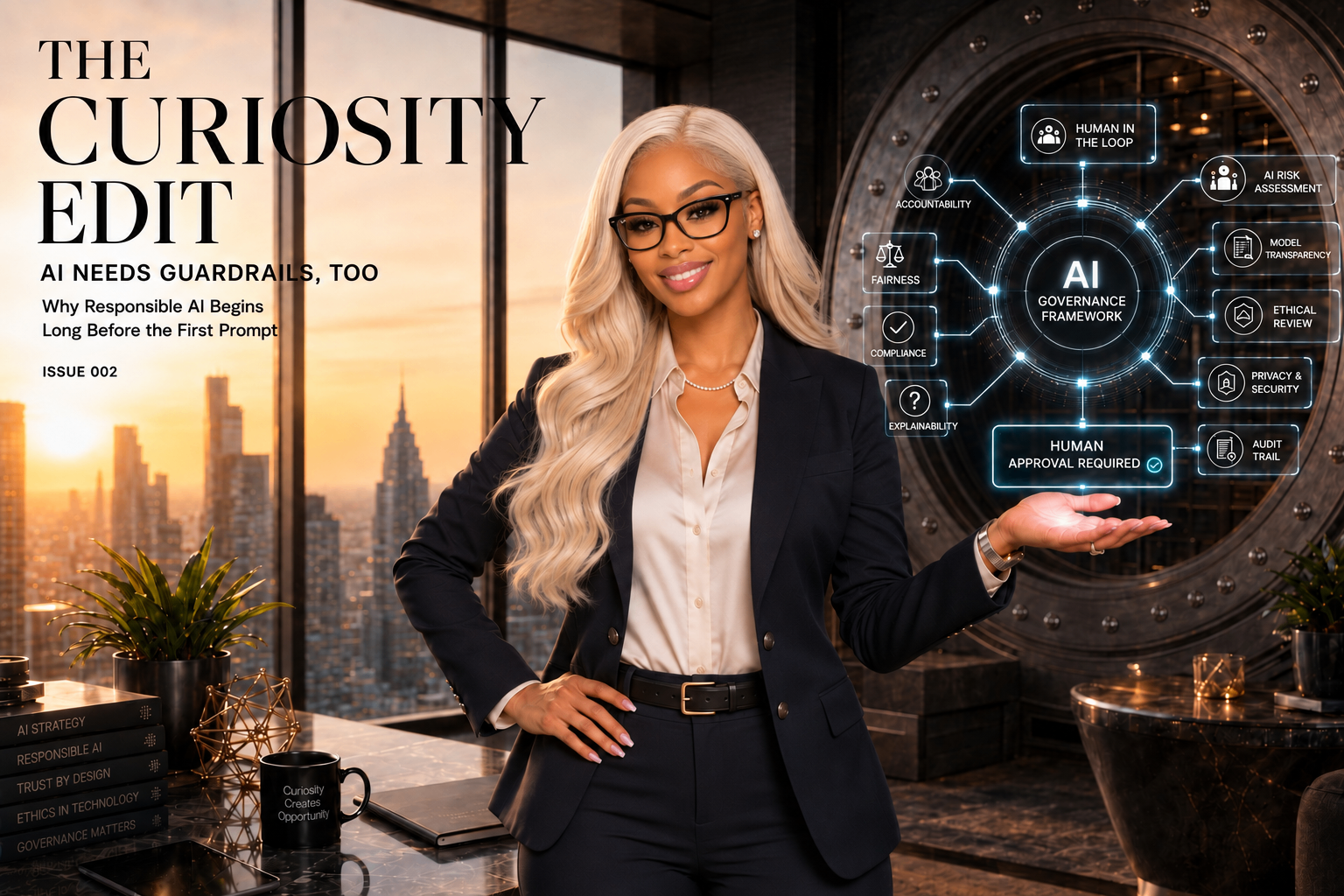
Artificial intelligence is moving fast.
Governments are adopting it. Businesses are scaling it. Individuals are using it to write, build, analyze, and automate work that once required hours of human effort.
The conversation is often framed around capability—what AI can do next.
But capability without governance isn’t innovation.
It’s risk.
The future won’t be defined by the organizations with the smartest AI. It will belong to the organizations that build AI people can trust.
That trust doesn’t emerge by accident. It is intentionally designed through governance, accountability, transparency, and human oversight.
AI doesn’t just need intelligence.
It needs guardrails.
We Already Know This Story
History has shown us that every transformative technology eventually requires rules.
Financial systems require regulation.
Medicine requires ethics.
Aviation relies on rigorous safety standards.
Cybersecurity depends on layered controls, continuous monitoring, and defense in depth.
Artificial intelligence is no different.
The challenge isn’t deciding whether AI should be governed.
The challenge is ensuring governance evolves as quickly as the technology itself.
Governance Isn’t the Brake—It’s the Steering Wheel
One of the biggest misconceptions surrounding AI governance is that it slows innovation.
In reality, effective governance enables organizations to innovate with confidence.
Well-designed governance frameworks help organizations answer practical questions before AI systems are deployed:
- Is the data reliable?
- Can the decision be explained?
- Who remains accountable?
- How is bias identified and mitigated?
- What happens when the model is wrong?
- How is the decision audited months—or years—later?
These aren’t obstacles to innovation.
They’re prerequisites for trustworthy innovation.
“Governance isn’t the brake on innovation—it’s the steering wheel.”
Guardrails Are Already Taking Shape
Around the world, organizations are beginning to formalize responsible AI practices through emerging governance frameworks.
Examples include:
- NIST AI Risk Management Framework (AI RMF)
- ISO/IEC 42001 Artificial Intelligence Management Systems
- ISO/IEC 23894 AI Risk Management
- The EU AI Act
- OECD AI Principles
Although each framework approaches governance differently, they share common themes:
- Transparency
- Human oversight
- Risk management
- Accountability
- Privacy
- Continuous monitoring
- Documentation
- Explainability
Notice what’s missing from that list.
None of them suggest replacing human judgment.
Instead, they strengthen it.
Cybersecurity Can’t Sit on the Sidelines
For cybersecurity professionals, AI governance isn’t someone else’s responsibility.
Security teams already understand concepts like:
- defense in depth
- least privilege
- zero trust
- continuous monitoring
- incident response
- auditability
- resilience
Responsible AI extends those same principles into intelligent systems.
As AI becomes integrated into security operations centers, fraud detection, identity verification, vulnerability management, and threat intelligence, cybersecurity professionals become critical stakeholders in ensuring those systems remain trustworthy.
Human in the Loop Is More Than a Buzzword
One concept continues to appear across modern AI governance conversations:
Human in the Loop (HITL).
It’s easy to reduce HITL to a simple approval button.
In practice, it’s much more significant.
Human oversight exists throughout the AI lifecycle:
- defining acceptable use
- validating training data
- evaluating outputs
- reviewing high-impact decisions
- monitoring model performance
- responding when systems drift or fail
The human isn’t there because AI is incapable.
The human is there because accountability cannot be delegated to an algorithm.
AI analyzes. Humans authorize.
The Governance Advantage
Organizations that embrace governance early will likely discover an unexpected competitive advantage.
- Customers trust them.
- Employees understand them.
- Regulators have confidence in them.
- Executives can explain their decisions.
- Innovation accelerates because the foundation is already in place.
Responsible AI isn’t about slowing technology down.
It’s about building systems that people are willing to depend on.
Final Thoughts
Artificial intelligence may shape the future.
But governance determines whether that future deserves our trust.
The organizations that lead tomorrow won’t simply deploy the most advanced AI.
They’ll deploy the most trustworthy AI.
And that begins long before the first prompt is ever written.
Continue the Conversation
Technology moves quickly.
Trust is built deliberately.
What role do you think governance should play as AI becomes more integrated into our daily lives?
✦ Limitless Reflection
“Artificial intelligence may shape the future. But governance determines whether that future deserves our trust.”
© Jadeofalltrades. Unauthorized reproduction prohibited.
Continue Exploring
Next Issue →
More from Cyber & Tech
Beauty, Bytes and Boundaries
When beauty can be generated and identity can be copied, is imitation still flattery, or is it identity theft with better lighting?
Continue ReadingWired Differently, Built for Cyber
How neurodiversity, lived experience, and unconventional thinking can strengthen cybersecurity teams
Continue ReadingScript Kiddies, Now With a Copilot
When anyone can generate the code, who understands the consequences?
Continue ReadingRelated Reading
The Nightmare on Pine St.
I Bought a Land Bank Property. Here’s What Nobody Put in the Listing.
Continue ReadingThe Power of Showing Up Whole
In workplaces built around unwritten rules, authenticity can feel risky. But difference is not a professional deficiency, and credibility should never depend on how closely someone resembles the traditional image of success.
Continue ReadingThe Lion's Gate Portal
Cosmic Symbolism, Personal Reflection, and Why Everyone Starts Talking About Sirius Every August
Continue ReadingThe Curiosity Edit · By Jadeofalltrades