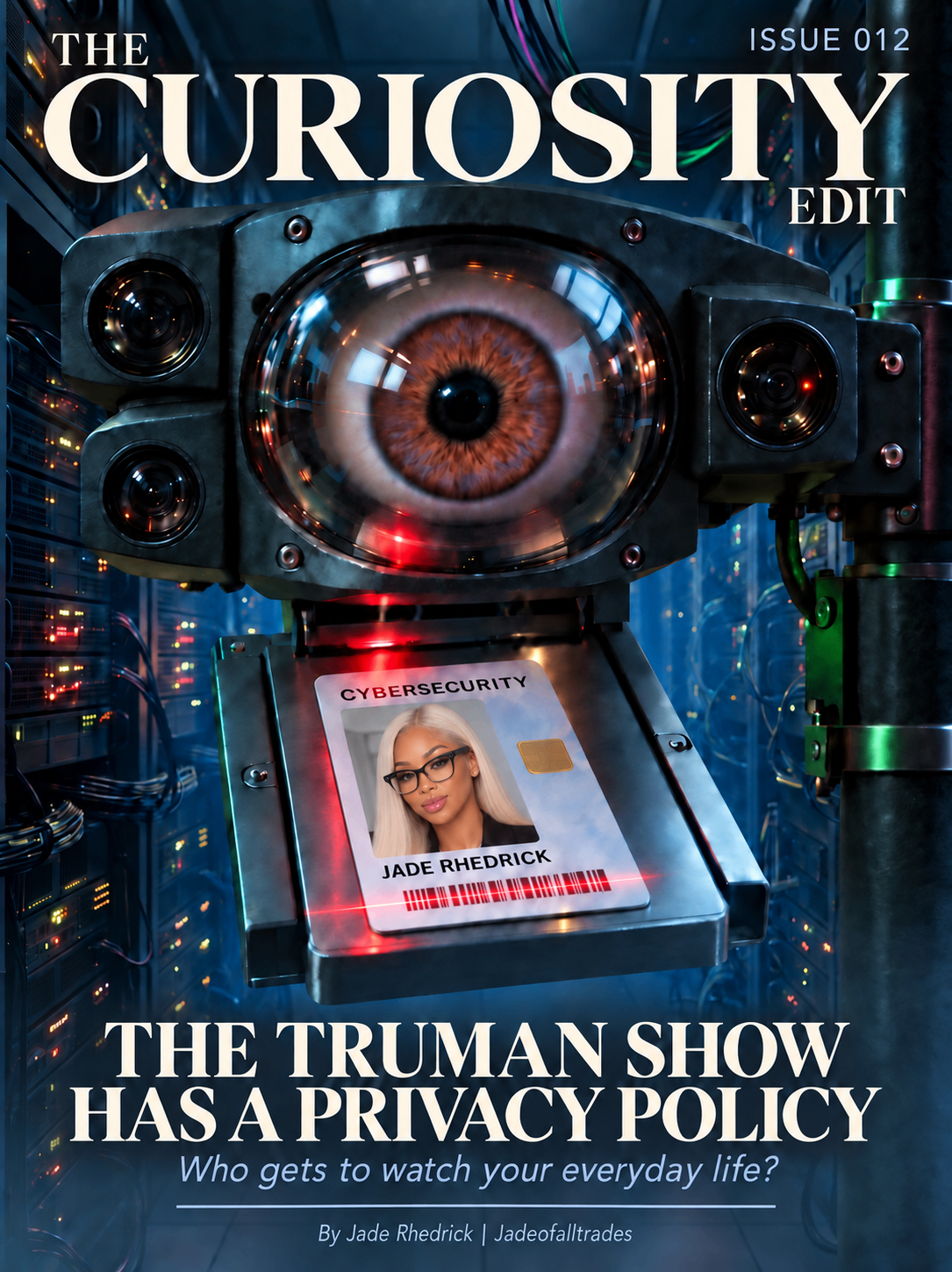
The Truman Show Has a Privacy Policy
Flock cameras, school laptops, and the disappearing boundary between being seen and being tracked
By Jade Rhedrick | Jadeofalltrades
How much of our private lives can be reconstructed without ever stepping inside our homes?
You close the curtains. Lock the door. Put your phone down.
For a moment, the day belongs to you.
But your doorbell may have recorded your arrival. A roadside camera may have captured your car. An app may hold a location history. Your child’s school laptop may still be operating under school-managed settings, even though the school day ended hours ago.
None of that proves someone is watching you. It does raise a question worth asking: How much of our private lives can be reconstructed without ever stepping inside our homes?
In The Truman Show, one man’s life becomes entertainment without his informed consent. Our reality is less coordinated, and in some ways more complicated. There is no evidence of one universal control room watching everyone. There are overlapping systems operated by schools, businesses, public agencies, neighbors, and ourselves.
The unsettling part is how easily ordinary moments can become records, and how those records can outlive the moment that created them.
Being visible is not the same as being searchable
Someone seeing you drive down a street is ordinary. A system retaining time-stamped sightings that can be searched across locations creates a different kind of visibility.
A trip to a clinic does not establish a diagnosis. Parking near a religious gathering does not prove belief. Sharing a route with another person does not establish a relationship. Yet repeated observations can invite those inferences.
That difference matters. Privacy includes room to move through the world without every encounter being preserved, connected, and interpreted later.
AI can reduce the effort involved in finding patterns. Machine learning can organize vehicle images; other systems can classify footage or rank content based on behavior. Those capabilities differ by product and configuration. They do not make every camera capable of recognizing every person, and they do not make every inference true. [1, 2]
Still, the policy question grows sharper: Who gets to turn scattered observations into a story about us, and what happens when that story is wrong?
The cameras that remember your commute
Flock Safety’s automated license plate readers capture plates and vehicle characteristics, such as make, color, and body type, to generate investigative leads. Its license plate reader (LPR) products do not use facial recognition, according to the company. An LPR is also distinct from a continuous-video CCTV system; Flock offers multiple products, so claims about one should not be generalized to all. [1]
The public safety benefits deserve a fair hearing. Vehicle sightings can help investigators locate stolen cars, pursue leads, and find missing people. The same ability to retrieve past sightings creates questions about ordinary drivers whose movements were recorded without any connection to an investigation.
A plate identifies a vehicle, not necessarily its driver. A visit identifies a location, not a motive. An automated match should be checked before it becomes the basis for action.
In August 2026, Flock announced a recommended seven-day retention period and additional accountability measures, including required case codes, misuse detection, and proactive account lockouts. Existing customer policies, legal requirements, and preservation for investigations can affect how long records remain. This is not a universal promise that every sighting disappears after seven days. [3]
Shorter retention can reduce exposure. It cannot answer every governance question. Who can search? Which agencies receive access? Who investigates misuse? Can a record be exported or preserved elsewhere? What consequences follow an unauthorized search?
A company policy is useful evidence of a commitment. It is not the same as an independently enforceable civil liberty.
For readers, the practical starting point is your local agency’s actual contract, retention policy, sharing rules, and audit process. A national product description cannot tell you every local implementation.
When the classroom follows a child home
School-issued Chromebooks can make education more accessible. They can also bring an institution’s digital rules into a family’s living room.
Google explains that administrators of managed Chromebooks can install apps, restrict features, monitor activity, and control device use. What a particular district can see depends on its settings, installed services, and policies. A managed Chromebook is not, by itself, evidence of covert webcam or microphone recording. [4]
The questions should be specific. Is browsing logged? Can teachers view screens? Are school documents or messages analyzed by a safety service? Does monitoring continue after hours? Does a school account carry monitoring onto a personally owned device?
Each answer changes the boundary.
Schools have legitimate responsibilities to support learning and protect students. A concerning search or message may warrant attention. But a child researching identity, health, family conflict, or an unfamiliar word also deserves context before an automated flag becomes a judgment.
My concern is the possibility of teaching children that curiosity always comes with an observer. A system intended to protect them should leave space for questions, mistakes, and development.
This is not merely hypothetical concern about education technology. In 2023, the FTC obtained an order against Edmodo over collecting children’s information without proper consent, using it for advertising, and improperly shifting compliance obligations to schools. That case concerns Edmodo, not an allegation against every school or Chromebook. It demonstrates why educational access should not become permission for unrelated commercial use. [5]
Parents should ask for a written explanation of monitoring scope, access, retention, and alternatives. Families should not need cybersecurity credentials to understand who can see their child’s work.
Your security camera needs security too
A camera can protect a home while creating another route into its private life.
In its 2023 Ring case, the FTC alleged excessive employee and contractor access to private videos and inadequate safeguards that allowed attackers to access accounts and cameras. These were allegations addressed through a settlement, not evidence that every current Ring device is compromised. [6]
The lesson reaches beyond one company. A recording system requires limits on both outside attackers and authorized insiders.
CISA and NSA have identified default credentials on devices including security cameras as a recurring security weakness. Internet exposure, outdated software, stolen passwords, and excessive permissions can create additional routes to unauthorized access. [7]
A camera in a bedroom captures something fundamentally different from a camera aimed at an entrance. A baby monitor, an indoor camera, or a remotely accessible recorder deserves deliberate decisions about placement, access, and whether recording is necessary at all.
The fact that someone can reach footage does not make that access authorized or lawful. A security failure does not transform a private moment into public property.
We also help build the archive
Some exposure comes from systems we cannot meaningfully avoid. Some comes from what we share.
A school uniform in a photo. A birthday post with a full birth date. A public workout route. A live location tag. A weekly pickup routine visible across several posts.
Each detail may feel harmless on its own. Together, they can make a family easier to identify or a routine easier to predict. That is a risk scenario, not proof that someone has assembled a dossier on every household.
The FTC’s 2024 examination of major social media and video streaming services found extensive data collection and monetization, with inadequate protections for children and teens. The report describes a business ecosystem with incentives to gather information far beyond the individual post. [2]
A private account limits an audience. It cannot prevent screenshots, copying, account compromise, or every form of platform collection.
We can enjoy sharing our lives while asking a second question before posting: Does this reveal something about another person that they should get to decide for themselves?
That question matters especially for children. Their childhood should not become a permanent public biography before they can choose its contents.
What does the law actually protect
In the United States, privacy protection depends on who is acting, what they obtain, how they obtain it, and which law applies.
The Fourth Amendment principally restrains government searches. It is not a universal prohibition on data collection by companies or neighbors. Private parties acting as government agents can raise different issues. Other statutes and state-law claims may govern private surveillance.
Under the familiar framework associated with Katz v. United States, courts consider whether someone actually expected privacy and whether that expectation is one society recognizes as reasonable. Property-based protections also matter; the expectation test is not the only route to Fourth Amendment protection. [8]
Two decisions show why technological capability is not the final answer.
In Kyllo v. United States (2001), the Supreme Court held that government use of technology not in general public use to obtain details of a home’s interior that previously required physical intrusion constituted a search, presumptively unreasonable without a warrant. The holding is specific, but its protection of the home is significant. [9]
In Carpenter v. United States (2018), the Court held that government acquisition of the historical cell-site location records at issue was a search, generally requiring a warrant. Keeping records with a wireless carrier did not automatically erase the protected privacy interest. The Court expressly limited its decision; it did not settle every question about cameras, location tools, or third-party records. [10]
Neither case creates a blanket ruling that all networked license plate surveillance is lawful or unlawful. Application depends on facts, jurisdiction, and developing law.
For children, FERPA generally protects education records at covered institutions and permits certain disclosures under defined exceptions. A vendor’s access under the school-official exception requires conditions including school control over the use and maintenance of protected information. FERPA does not automatically cover every piece of technical data. [11]
COPPA applies to covered online services collecting personal information from children under 13. School authorization has limits tied to educational purposes. The updated rule adds restrictions around third-party disclosures and retention, but COPPA is not a universal privacy law for all teenagers. [12]
State privacy laws, recording laws, computer-access laws, and claims involving intrusion may add protections. Audio and video can be treated differently. A device’s ownership, a signed policy, or a terms-of-service checkbox does not settle every legal question.
A natural-rights argument is also broader than a particular legal remedy. We can believe people deserve autonomy and dignity while recognizing that the available remedy depends on existing law.
Yes we should expect privacy at home
My answer is yes. People should retain meaningful privacy inside their homes, and the law recognizes the home as a particularly protected place against government intrusion. That protection has exceptions and does not guarantee that every connected device keeps every record confidential. [9]
But buying a smart device should not be treated as consent to unlimited observation.
Nor should widespread surveillance become its own justification. If exposure alone makes privacy expectations unreasonable, then the more information institutions collect, the fewer boundaries we are allowed to demand. That is a policy trap worth resisting.
The boundary I would defend is purpose, necessity, and proportionality: collect what a legitimate task requires, restrict who can use it, and do not quietly expand its purpose.
A school should be able to explain why a monitoring tool is necessary and where its reach ends. Police should face meaningful oversight when reconstructing a person’s movements. A neighbor’s security system should avoid looking into another household’s intimate spaces. A platform should not treat participation as permission to build every possible inference about a person.
Those are proposed standards, not a description of universally enacted law.
Safety systems can have legitimate uses. Their value should be demonstrated alongside their costs, with consequences for misuse and avenues to challenge mistakes.
What we can realistically gatekeep
Perfect invisibility is not a realistic goal. Meaningful reductions in exposure are.
Protect intimate spaces. Keep cameras out of bedrooms and bathrooms where possible. Consider whether indoor recording is needed, and prefer less intrusive arrangements when they meet the same need. Physical shutters can block a camera’s view; they do not stop microphone capture, browsing logs, or other telemetry.
Secure the recordings you choose to create. Use unique passwords and multifactor authentication where offered. Update cameras, recorders, and routers. Remove old shared users and disable unnecessary remote access. Avoid directly exposing a recorder to the internet. These are risk reductions, not guarantees. [7]
Separate school use from family use. Keep sensitive personal activity off school-managed devices and accounts where practical. Ask the district before changing managed settings. Closing a laptop does not necessarily end account-based collection or delete existing records.
Share routines less precisely. Post outings after leaving. Avoid repeatedly publishing exact routes, pickup times, house details, or children’s identifying information. Ask relatives to follow the same boundaries.
Reduce collection at the source. Review location, microphone, camera, contact, and photo permissions. Turn off unnecessary location history and advertising personalization where controls exist. Deletion requests can help, but legal retention, copies, and previously shared information can limit their effect.
Keep some life outside the archive. Use an offline journal for private reflection. Leave some conversations unrecorded. Let a child’s embarrassing moment end when the moment ends.
Demand institutional limits. Personal settings cannot change a roadside camera’s policy. Ask public agencies about retention, sharing, audits, and access controls. Use school-board meetings and public-records processes to seek accountable decisions.
Privacy should not require families to purchase their way out of essential education or public life.
Five questions worth sending your school
- Which monitoring services and extensions operate on school devices and accounts, and what does each collect?
- Does monitoring operate after school, at home, or on personal devices signed into school accounts?
- Can anyone view screens, activate cameras or microphones, or inspect messages? Under what authorization?
- Who receives data, how long is it kept, and may vendors use it for advertising or model training?
- How can families inspect relevant records, challenge incorrect flags, request deletion where available, or obtain a workable alternative?
A clear answer is more useful than a general assurance that a product is compliant.
The right to an unrecorded life
I do not think every ordinary moment is secretly part of a coordinated broadcast. I do think we have built systems that make ordinary moments easier to retrieve than many people understand.
That is enough reason to ask harder questions.
Can a child explore a question without it becoming a lasting label? Can someone visit a friend without that visit becoming searchable history? Can a family come home and feel that the inside of their life belongs to them?
Privacy gives us room to change our minds, recover from mistakes, and develop without an audience. It supports freedom because people need space to think and associate without automatic scrutiny.
We should protect that space before constant exposure feels inevitable.
And if the modern Truman Show comes with a privacy policy, I would still like to know who controls the cameras, who gets the footage, and whether there is a real exit.
Stay curious. Ask who is watching. Ask who can search.
Sources and reading
U.S. focus. Research checked October 2, 2026. Legal discussion is general education; outcomes depend on facts and jurisdiction. Examples are distinguished from hypothetical risks and proposed policy boundaries.
- Flock Safety, License Plate Readers and What Do Flock Cameras Actually Capture. Vendor descriptions, not independent findings.
- FTC, Social Media and Video Streaming Surveillance Report announcement, September 19, 2024.
- Flock Safety, Privacy Accountability Security and Transparency Safeguards, August 13, 2026; Data Deletion and Retention. Announced policies require local verification.
- Google, Check if your Chromebook is managed.
- FTC, Edmodo enforcement announcement, May 23, 2023.
- FTC, Ring enforcement announcement, May 31, 2023.
- CISA and NSA, Top Ten Cybersecurity Misconfigurations; CISA, Internet Exposure Reduction Guidance.
- Constitution Annotated, Katz and Reasonable Expectation of Privacy Test; Current Doctrine on Searches and Seizures.
- Supreme Court, Kyllo v United States, 533 U.S. 27 (2001), majority opinion.
- Supreme Court, Carpenter v United States, 585 U.S. 296 (2018), majority opinion.
- U.S. Department of Education, Protecting Student Privacy While Using Online Educational Services, February 2014.
- FTC, COPPA Frequently Asked Questions and 2025 Rule Changes.
Continue Exploring
Next Issue →
More from Cyber & Tech
When the Hack Hits Home
The cyber threats behind your morning coffee, commute, and prescription refill
Continue ReadingThe Golden Opportunity Inside the LinkedIn DM I Almost Didn’t Trust
From an unexpected invitation to CompTIA’s Network of Experts, and why practical, responsible AI education matters now
Continue ReadingThe Psychology of the Scam
Hackers Don't Always Hack Computers. Sometimes They Hack People.
Continue ReadingRelated Reading
The Nightmare on Pine St.
I Bought a Land Bank Property. Here’s What Nobody Put in the Listing.
Continue ReadingThe Power of Showing Up Whole
In workplaces built around unwritten rules, authenticity can feel risky. But difference is not a professional deficiency, and credibility should never depend on how closely someone resembles the traditional image of success.
Continue ReadingThe Lion's Gate Portal
Cosmic Symbolism, Personal Reflection, and Why Everyone Starts Talking About Sirius Every August
Continue ReadingThe Curiosity Edit · By Jadeofalltrades