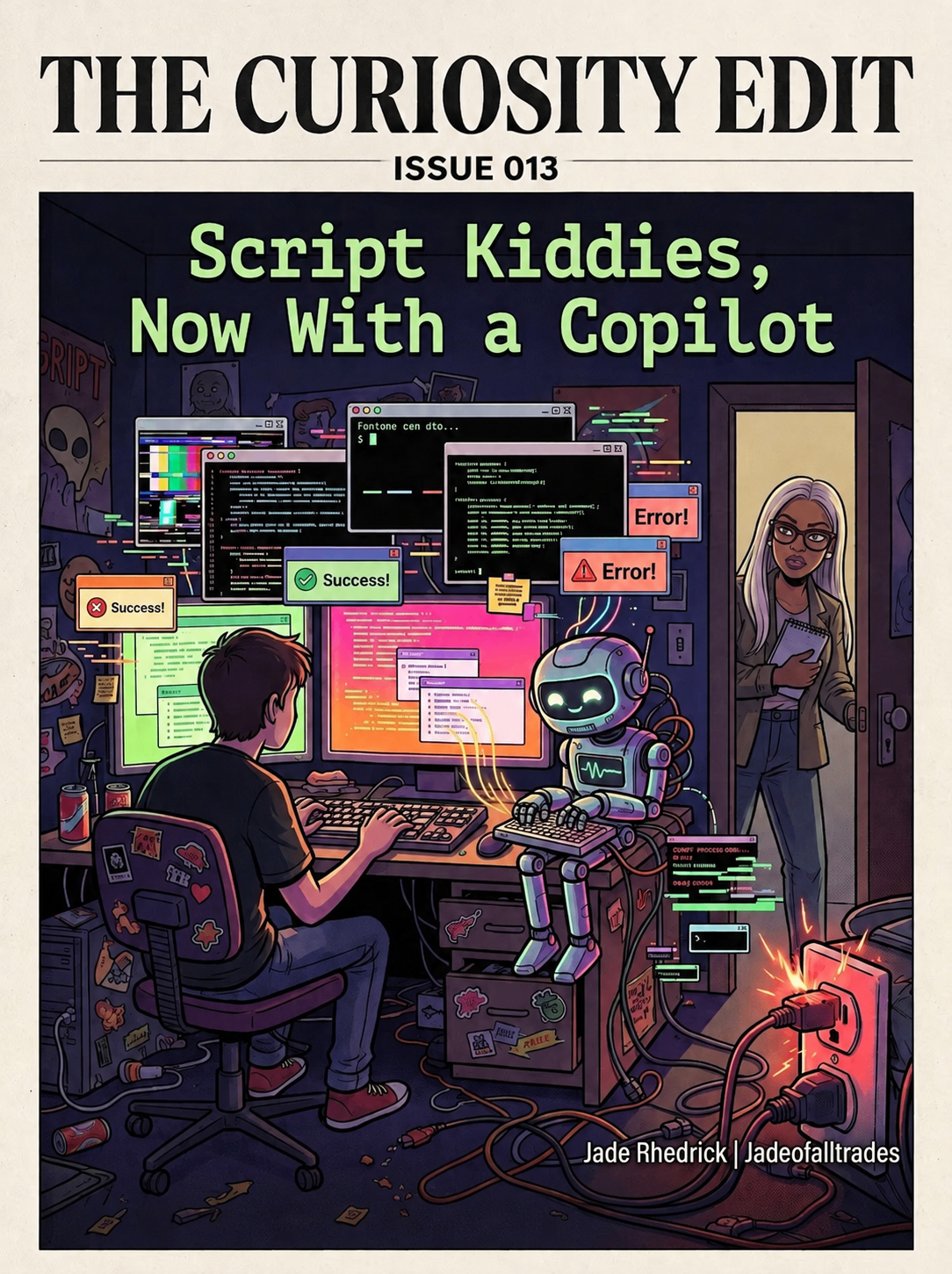
Script Kiddies, Now With a Copilot
When anyone can generate the code, who understands the consequences?
By Jade Rhedrick | Jadeofalltrades
Technical reach can expand before technical judgment catches up.
Let’s Go Down the Rabbit Hole 🐇
Once upon a time, you had to find the script.
Now you can describe what you want it to do.
That shift is opening doors for entrepreneurs, students, career changers, and people who have spent years being told that building something technical was beyond their reach. A conversation can become a prototype. An idea can become a working tool.
As a cybersecurity student, enterprise technology professional, and someone who has vibe coded quite a bit, I know the excitement of making something tangible through a conversation with AI. I believe curiosity belongs in tech, and I see the opportunity.
I also see the question hiding behind the impressive demo: Does the person running this understand what it can actually do?
Cybersecurity has an old, dismissive nickname for someone who uses hacking tools without much understanding of their inner workings: script kiddie. The “kiddie” part describes perceived inexperience, not necessarily age.
Conversational coding gives that label an uncomfortable update. Someone may no longer need to download another person’s script. They can ask an AI system to generate one, change it, explain an error, and try again.
Technical reach can expand before technical judgment catches up.
And “it worked” can be the beginning of the problem.
First, Let’s Retire the Beginner Shame
Using AI to write code does not make someone a script kiddie. Neither does being new to technology.
Experienced developers use assistants. Beginners learn with them. People with disabilities may find new ways to participate through them. None of those activities deserves to be collapsed into a stereotype about reckless hackers.
Here, vibe coding means a conversational approach to building software in which a person describes the result they want and iterates on generated code. The term is also used more narrowly for a workflow where the person pays little attention to the code itself. Those are meaningfully different levels of involvement.
The important distinction is how someone learns, checks, and takes responsibility for the output.
A beginner who asks questions, tests within an authorized environment, and seeks review is developing competence. Someone who deploys a tool they cannot evaluate is taking on risks they may not recognize. Someone deliberately using it to harm others is making another choice entirely.
Inexperience, recklessness, and malicious intent should not be treated as synonyms.
From Borrowed Scripts to Delegated Decisions
Reusing code is hardly new. Modern software depends on libraries, frameworks, and tools written by other people. Security professionals have long relied on automation.
AI adds a different kind of interaction: the tool can respond to instructions, revise its output, and, when connected to the necessary systems and permissions, take actions.
An assistant that suggests a function and an agent that executes commands have different authority. Their risks depend on what they can access and change.
Imagine a learner practicing in a deliberately isolated lab. They can use generated code to explore a concept, inspect what happened, and explain why. Now imagine the same habit carried into a live environment with real records and broad access. A small misunderstanding can affect other people.
That example is hypothetical, but the distinction matters: the permissions attached to a tool help determine the consequences of its mistakes.
The question is no longer simply whether someone can produce code. It is whether they can judge the behavior that code produces.
“Vibe Hacking” Has Entered the Conversation
There is evidence that malicious actors are using this kind of assistance.
In August 2025, Anthropic reported cases involving misuse of Claude, including a data-extortion operation and an actor with basic coding skills who developed and sold AI-generated ransomware. The company said the ransomware actor depended on AI for components they could not implement or troubleshoot independently. [1]
Its September 2026 report describes operations in which AI executed or coordinated parts of intrusions while humans set targets and reviewed results. [2]
These are a provider’s accounts of activity observed through its systems. They offer concrete examples, but do not measure the prevalence of AI-assisted cybercrime across the whole internet. They also do not establish that every actor involved was a novice.
The UK’s National Cyber Security Centre offers a wider assessment: AI is expected to make parts of cyber intrusion more efficient and effective and broaden access to intrusion capabilities through 2027. Its assessment also anticipates defensive benefits and distinguishes different levels of attacker capability. [3]
These sources support concern about expanded access and delegated work. They do not establish that any person with a chatbot can compromise any system.
My editorial interpretation is this: defenders cannot safely dismiss a threat merely because the person behind it appears inexperienced. Borrowed capability can still cause real harm.
The Same Gap Can Show Up on Our Side of the Screen
The malicious-use story is only one part of this issue.
A well-intentioned founder can build a customer portal. A community organizer can create a registration tool. A student can automate a task. Each might celebrate a successful demonstration without knowing whether the system protects the information moving through it.
For illustration, a generated app could look polished while allowing one account to access another account’s records. A convenient automation could have more permissions than its task requires. A troubleshooting change could remove a protection while fixing the visible error.
These are possible failure modes, not a claim that every AI-generated application contains them.
GitHub’s documentation for Copilot inline suggestions warns that generated code can be inaccurate or create security risks. It calls for review and testing, particularly in sensitive applications. [4]
An assistant can help with that process. Its reassuring explanation should not become the only evidence that its own output is safe.
If the tool writes the code, tells you the code is fine, and congratulates you on shipping it, you still need a way to check the result.
“The confetti is not a security review.”
Confidence Has Become Easy to Generate
A fluent explanation can feel like understanding. A finished interface can feel like readiness. A successful test can feel like proof that every important condition has been covered.
Those feelings are understandable. Building something that works is exciting, especially when technical spaces have made you question whether you belong.
But confidence needs evidence.
Can you explain what data the tool receives? What it sends elsewhere? Which actions require permission? What happens when someone enters unexpected information? How would you notice a failure, and how would you stop it?
You do not need to memorize every line of code to take responsibility for a system. You do need enough understanding, documentation, and qualified support to evaluate the consequences of using it.
That standard applies to experienced teams too. A senior title does not make a rushed deployment safer.
For Cyber Learners, Let the Assistant Deepen the Lesson
Use AI to help you investigate, then demonstrate what you learned.
Ask it to explain the assumptions behind a solution. Compare that explanation with documentation. Predict the result before running a small experiment in a lab. Change one condition and observe what happens. Write down where your prediction was wrong.
Practice within systems you own or environments where the activity is explicitly authorized. A public website is not automatically a practice lab, and an assistant cannot grant permission on someone else’s behalf.
The goal is to build an increasingly accurate understanding of the systems you touch.
Networking, operating systems, identity, permissions, and secure design remain useful because they help you recognize when a generated answer does not fit reality. Fundamentals give you questions to ask when the output looks convincing.
You belong in tech while you are learning. Belonging and accountability can grow together.
For Builders and Leaders, Ask Better Questions Before Launch
“Did you use AI?” tells us less than we might think.
More useful questions are: Who owns this tool? What can it access? What evidence supports its readiness? Who can maintain it when the original conversation is gone?
For a prototype, use synthetic data and limited access while you explore. Before moving into real use, make the review match the stakes. A tool handling customer records needs more scrutiny than a personal color-palette experiment.
Check access controls, protect credentials, review dependencies, test failure conditions, and prepare a way to recover from an unsuccessful change. These practices support responsible development; they do not guarantee security.
Giving an agent more authority should be a deliberate decision tied to its task. Make its actions visible and retain a clear way to intervene.
Leadership has a role here. If the only thing an organization rewards is shipping quickly, people have an incentive to skip the work that makes speed sustainable. Teams need time and qualified support to turn a working demo into a dependable service.
The Label Is Getting Less Useful. The Responsibility Is Getting Clearer.
“Script kiddie” can be a catchy headline. As a way to assess risk, it has limits.
It tells us little about the access someone has, the tools they can borrow, the decisions they can delegate, or the damage they can cause. And it can discourage precisely the learners cybersecurity needs.
The more revealing questions concern behavior: Are they operating with authorization? Do they understand enough to evaluate what they are doing? Are they checking outcomes? Can they recognize when they need help?
AI can help someone become more capable. It can also make it easier to appear capable without building the understanding underneath.
Our challenge is to keep the door open while strengthening what happens after someone walks through it.
The Curiosity Check
- Can you explain what your AI-assisted tool does beyond the result on the screen?
- What can it access, change, or expose if it behaves unexpectedly?
- Which part of its output have you independently checked?
- Are you using assistance to deepen your understanding, or skipping every opportunity to build it?
- What evidence would you want before trusting someone else’s generated tool with your information?
✦ Limitless Reflection
“Am I becoming more capable of judging the work, or just more comfortable accepting it?”
© Jadeofalltrades. Unauthorized reproduction prohibited.
Further Down the Rabbit Hole
- Detecting and countering misuse of AI: August 2025 | Anthropic. Published August 27, 2025. Provider-reported cases, including data extortion and AI-assisted ransomware development.
- Detecting and countering misuse of AI: September 2026 | Anthropic. Provider-reported cases and analysis of malicious AI use, including delegated cyber operations.
- Impact of AI on cyber threat from now to 2027 | UK National Cyber Security Centre. Published May 7, 2025. An intelligence assessment with probabilistic judgments and a defined forecast horizon.
- Application card: GitHub Copilot inline suggestions | GitHub Docs. Product-specific documentation covering limitations, security risks, review, and testing.
Sources checked October 7, 2026. Reported cases are limited to the providers’ visibility and are not estimates of internet-wide prevalence. Hypothetical examples and recommendations elsewhere are editorial analysis.
“Copilot” in the headline is a metaphor for AI coding assistance broadly. The GitHub documentation cited here does not imply that GitHub Copilot was involved in the malicious campaigns described.
Continue Exploring
Next Issue →
More from Cyber & Tech
The Truman Show Has a Privacy Policy
Flock cameras, school laptops, and the disappearing boundary between being seen and being tracked
Continue ReadingWhen the Hack Hits Home
The cyber threats behind your morning coffee, commute, and prescription refill
Continue ReadingThe Golden Opportunity Inside the LinkedIn DM I Almost Didn’t Trust
From an unexpected invitation to CompTIA’s Network of Experts, and why practical, responsible AI education matters now
Continue ReadingRelated Reading
The Nightmare on Pine St.
I Bought a Land Bank Property. Here’s What Nobody Put in the Listing.
Continue ReadingThe Power of Showing Up Whole
In workplaces built around unwritten rules, authenticity can feel risky. But difference is not a professional deficiency, and credibility should never depend on how closely someone resembles the traditional image of success.
Continue ReadingThe Lion's Gate Portal
Cosmic Symbolism, Personal Reflection, and Why Everyone Starts Talking About Sirius Every August
Continue ReadingThe Curiosity Edit · By Jadeofalltrades