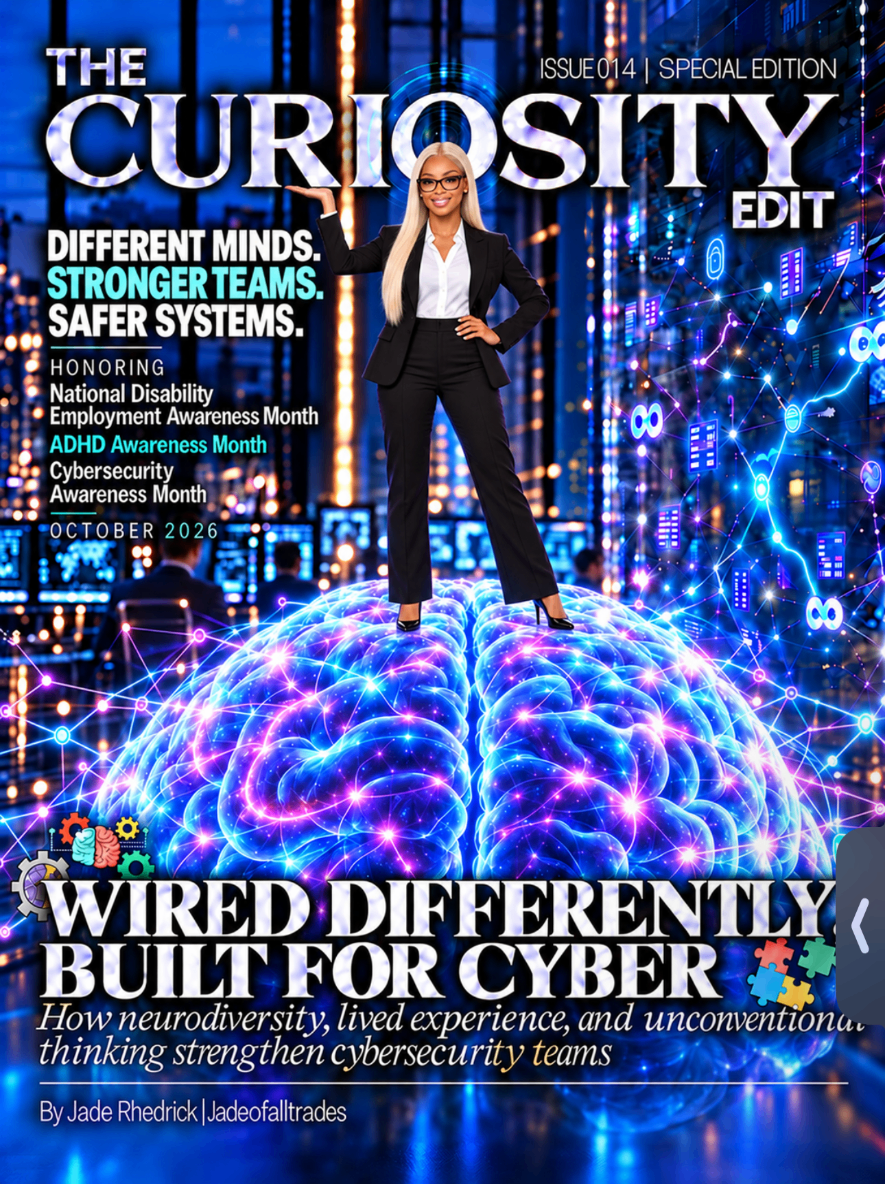
October 2026 Special Edition
Wired Differently, Built for Cyber
How neurodiversity, lived experience, and unconventional thinking can strengthen cybersecurity teams
By Jade Rhedrick | Jadeofalltrades
Keep this issue for offline reading. Delivered instantly, and emailed to you.
There is room in cyber for more than one kind of mind.
Let’s Go Down the Rabbit Hole 🐇
October is National Disability Employment Awareness Month, ADHD Awareness Month, and Cybersecurity Awareness Month. As a Scrum Master and cybersecurity student who is not currently part of the cybersecurity workforce, I find these observances invite a question that belongs in every conversation about who gets to enter and contribute to this field: Who gets recognized as having the right kind of mind for cybersecurity? [1–3]
October 10 also marks World Mental Health Day, bringing another question into the conversation: Are we building workplaces where people can contribute without sacrificing their well-being? [4]
I don’t think these conversations should happen in separate rooms. We spend one part of October talking about the people and practices that keep us safer online, and another recognizing disabled workers and people whose minds work differently. Surely these conversations can share a calendar invite.
Put them together, and a powerful point comes into focus: you can be neurodivergent, be drawn to cybersecurity, and build a successful career in it. Your way of thinking does not disqualify you from protecting people and systems.
This is already part of the workforce’s story. In an April 2026 analysis of its latest Cybersecurity Workforce Study, ISC2 reported that 1,852 of 16,029 respondents worldwide, approximately 12%, identified as neurodivergent. That is a finding about the survey sample, not a population estimate or a measure of anyone’s technical ability. It does tell us this conversation belongs in the present tense. [5]
Cybersecurity is often presented as a field for people who can follow a playbook, think quickly under pressure, and communicate in a very particular way. Those skills can matter. But the work also depends on people who notice the detail everyone else passed over, ask why a rule exists, imagine what could go wrong three steps from now, or stay with an investigation after the obvious answers have run out.
Some of those people are neurodivergent. Some have disabilities, unconventional career paths, or life experiences that shaped the way they read risk. Neurodivergence and disability can overlap, but neither describes every person the same way. No label guarantees a cybersecurity skill. Nobody should have to hide who they are to earn a place on the team, either.
“The question is not whether someone thinks like the rest of the team. It is whether the team can recognize what their thinking reveals.”
The Threat Model We Forget to Examine
In security, a threat model asks us to look at a system, identify what matters, consider how it could fail, and question assumptions before an adversary does. We examine boundaries and overlooked entry points. We ask what happens when someone takes a path we did not expect.
Now apply that same curiosity to the way we build teams.
What happens when a hiring process rewards polished interview performance more than careful analysis? When the loudest person in an incident call becomes the default authority? When a teammate spots an inconsistency but has no time to explain it before the meeting moves on?
Those are human blind spots, and they can become security blind spots.
Consider an illustrative hiring scenario: a candidate struggles with rapid-fire questions but produces a clear analysis of a suspicious login sequence when given a realistic exercise and time to explain their reasoning. If the role depends on investigation, the exercise gives the team useful evidence about the work itself. The interview should make that evidence easier to see.
There are real examples of employers changing the process. Microsoft’s Neurodiversity Hiring Program uses an extended interview process that includes preparation activities and opportunities to learn about the workplace. The program illustrates that interview design can change while the goal remains identifying qualified candidates. Its existence alone does not establish better security outcomes. [6]
A person who asks unusually specific questions may uncover a missing trust boundary. Someone who connects scattered details may see that three low-priority alerts tell one larger story. A teammate who challenges “we’ve always done it this way” may surface an attack path hiding inside an accepted process.
Lived experience can shape those questions, too. Someone who has navigated inaccessible systems may ask who a security control assumes its users are. A former customer-support professional may recognize where a confusing process invites a workaround. Someone who coordinates across business and technology teams may notice that a risk persists because everyone believes someone else owns it.
Experience does not replace technical knowledge. It can help us decide which assumptions deserve a closer look.
These are possibilities, not personality guarantees. Cybersecurity teams do not need a new set of stereotypes disguised as compliments. Give people meaningful ways to contribute, then test their observations against evidence.
Where Different Thinking Can Show Up in Cyber
The following examples are illustrative workplace scenarios, not claims that a particular diagnosis produces a particular skill.
Pattern recognition and anomaly detection. A late-night login might be routine. Pair it with an unexpected password reset and a new mailbox-forwarding rule, and it deserves a closer look. The useful skill is connecting the events, checking context, and investigating without treating suspicion as proof.
Investigative persistence. An analyst notices that an incident timeline still has a gap after the first explanation seems convincing. They check another log source and document what remains unknown. Sustained attention can help, but it needs boundaries, a handoff, and permission to stop for rest. Curiosity should not require an all-night subscription.
Curiosity and nonlinear thinking. A teammate traces a problem across user behavior, a vendor process, and an internal approval gap. Attackers are under no obligation to stay inside our organization charts. Our questions should be allowed to travel, too.
Scenario mapping and risk anticipation. During a tabletop exercise, someone asks what happens if the administrator needed to approve account recovery is also locked out. That question can reveal a dependency before a real incident does.
Direct communication and attention to inconsistencies. “That explanation doesn’t match the logs” can be the most useful sentence in the room. Make it safe to say, and expect the speaker to show their evidence. Candor and respect can coexist.
Creative problem-solving when the playbook ends. A security team reviewing an authentication flow asks whether the instructions and recovery options work for people using assistive technology. Testing with affected users can expose barriers that a standard checklist missed. Involve people in designing the solution instead of assuming what they need.
The Part the Inspirational Posters Leave Out
There can be real difficulty alongside ability. Shifting priorities, sensory demands, ambiguous instructions, social expectations, and high-pressure calls can make an already demanding job harder. Someone may be excellent at finding the root cause and still need a template to organize the report. A person may think clearly during an incident and need quiet afterward to recover.
Calling every difference a “superpower” can make those needs harder to say out loud. It can imply that support has to be earned through exceptional output. It can turn a human being into a hiring slogan.
And masking can have a cost. In a qualitative study published in Autism in Adulthood, autistic adults described exhaustion and other harms associated with camouflaging their autistic characteristics. Those accounts concern autistic participants, not every neurodivergent person, but they give us reason to take the effort of fitting in seriously. [7]
Constantly editing every question, suppressing natural communication, or performing ease in an overwhelming environment can consume energy that someone needs for work, home, or simply getting through the day with less strain.
The cybersecurity data adds another reason to pay attention. ISC2’s April 2026 analysis found that 53% of neurodivergent respondents reported exhaustion from keeping up with emerging threats and technologies, compared with 46% of respondents who did not identify as neurodivergent. The survey describes reported experiences; it does not establish that neurodivergence caused the exhaustion. [5]
We should be able to talk about strengths without pretending the friction isn’t real.
World Mental Health Day belongs here, too. Neurodivergence and mental health are not interchangeable, although people’s experiences can overlap. The World Health Organization recommends addressing workplace risks through changes to working conditions, including organizational interventions, rather than relying only on individuals to cope. [8]
For a security team, I would start with workload, interruptions, on-call coverage, and recovery after an intense incident. A self-care reminder has limited usefulness if the operating model makes rest impossible.
The people doing the protecting deserve support, including when they need to step back. Their well-being matters beyond what it contributes to the team.
Making Room to Work Differently
The goal is not to reveal every private detail at work. It is to understand how you do your best work and build conditions that let you do it sustainably.
Start by noticing your patterns. Which tasks bring clarity? Which interruptions derail you? Do you process a complex question better in writing, in conversation, or after some thinking time? What happens to your accuracy when several urgent requests arrive at once?
Then make the support practical: an agenda, a clear owner and deadline, questions shared before a meeting, a checklist for recurring incident steps, quieter space, or a written recap after a call.
The cost conversation deserves evidence, too. In its report updated in September 2025, the Job Accommodation Network found that 61% of the 1,425 employers who provided accommodation-cost information reported no implementation cost. Another 33% reported a one-time expense, with a median of $300 among those providing dollar amounts; 6% reported ongoing costs. These were employers who had contacted JAN, not a representative sample of every workplace, and individual needs vary. Still, assuming every accommodation requires a large budget can stop a useful conversation before it starts. [9]
For an everyday work practice, a request might be as simple as: “Could we capture the decision, owner, and deadline in writing after these calls? That helps me follow through accurately.”
Disability-related accommodation requests have additional considerations. In the United States, EEOC guidance says a request can use plain language and need not start in writing or use special legal terms. An employer may request reasonable supporting documentation when the disability or accommodation need is not obvious, and medical information is subject to confidentiality requirements. You do not need to make your health history a team discussion to explore support. [10]
For leaders and teammates, start with changes people can feel in the workday:
- Make contribution possible in more than one format. Accept written observations alongside live discussion. During incidents, assign someone to monitor the approved chat channel so useful evidence is not overlooked.
- Make priorities visible. Name the decision, owner, deadline, and escalation path. If five tasks are all “urgent,” help determine the order.
- Make hiring relevant to the job. Use accessible, realistic exercises and clear criteria. Evaluate the quality of the analysis and explanation without treating eye contact or conversational polish as a shortcut for competence.
- Make recovery operational. Plan backup coverage, document handoffs, and provide opportunities to rest after demanding incidents.
- Make inclusion extend to advancement. Offer access to training, stretch assignments, mentorship, and leadership opportunities. Ask about career goals instead of deciding where someone belongs based on a label.
You can contribute without managing a team. Share the agenda. Credit the colleague whose written observation changed the investigation. Ask what helps instead of diagnosing someone’s behavior. Use the language people prefer for themselves, and protect what they choose to share privately.
A strong team gives people clear goals, useful tools, and enough trust to surface what they see. Ask whether a change helped, and adjust it with the person using it.
A Question to Take With You
The next time someone approaches a problem differently, pause before treating the difference as a disruption. What assumption might they be testing? What risk might they see? What would help them share that insight clearly and safely?
This October, turn awareness into one practical change. Offer a written way to contribute. Clarify an ambiguous handoff. Revisit a hiring step. Make room for recovery after an intense incident.
Choose one change this week. Ask the people affected whether it helped. Keep what works.
Cybersecurity has always depended on curiosity. Give more people a fair chance to put theirs to work.
✦ Limitless Reflection
“What might your team see differently if everyone had a genuine chance to contribute?”
© Jadeofalltrades. Unauthorized reproduction prohibited.
Further Down the Rabbit Hole
Sources checked October 8, 2026. Statistics retain the dates and scope of the underlying research; examples identified as illustrative are not reported incidents.
- U.S. Department of Labor: National Disability Employment Awareness Month. Background on the October observance.
- CHADD: Events Calendar. October 2026 ADHD Awareness Month programming and education.
- CISA: Cybersecurity Awareness Month. October online-safety awareness and resources.
- World Health Organization: World Mental Health Day. October 10 observance.
- ISC2, April 2026: Neurodivergence in the Cybersecurity Workforce: A Snapshot. Analysis of workforce survey responses, including self-identification and reported exhaustion. Findings describe respondents and do not demonstrate that neurodivergence causes particular skills or outcomes.
- Microsoft Careers: Neurodiversity Hiring Program. The employer’s description of its extended interview process.
- Bradley, Shaw, Baron-Cohen, and Cassidy, 2021: Autistic Adults’ Experiences of Camouflaging and Its Perceived Impact on Mental Health. Qualitative research published in Autism in Adulthood; findings concern autistic participants’ accounts.
- World Health Organization: Mental Health at Work. Workplace risks and organizational approaches to supporting mental health.
- Job Accommodation Network, updated September 17, 2025: Cost and Benefits of Accommodations. Employer survey covering contacts from 2019–2024; cost findings reflect 1,425 respondents who supplied cost information. The $300 figure is a median one-time cost, not an average across all accommodations.
- U.S. Equal Employment Opportunity Commission: Enforcement Guidance on Reasonable Accommodation and Undue Hardship under the ADA. U.S. guidance on requests and documentation. See also The ADA: A Primer for Small Business for confidentiality requirements. Individual circumstances matter.
Continue Exploring
Next Issue →
More from Cyber & Tech
Script Kiddies, Now With a Copilot
When anyone can generate the code, who understands the consequences?
Continue ReadingThe Truman Show Has a Privacy Policy
Flock cameras, school laptops, and the disappearing boundary between being seen and being tracked
Continue ReadingWhen the Hack Hits Home
The cyber threats behind your morning coffee, commute, and prescription refill
Continue ReadingRelated Reading
The Nightmare on Pine St.
I Bought a Land Bank Property. Here’s What Nobody Put in the Listing.
Continue ReadingThe Lion's Gate Portal
Cosmic Symbolism, Personal Reflection, and Why Everyone Starts Talking About Sirius Every August
Continue ReadingCosmic Wanderlust: The Stars Said Pack a Bag
An Astrocartography Rabbit Hole on How Place Shapes Who We Become
Continue ReadingThe Curiosity Edit · By Jadeofalltrades