November 2026 Special Edition
Beauty, Bytes and Boundaries
When beauty can be generated and identity can be copied, is imitation still flattery, or is it identity theft with better lighting?
By Jade Rhedrick | Jadeofalltrades
Keep this issue for offline reading. Delivered instantly, and emailed to you.
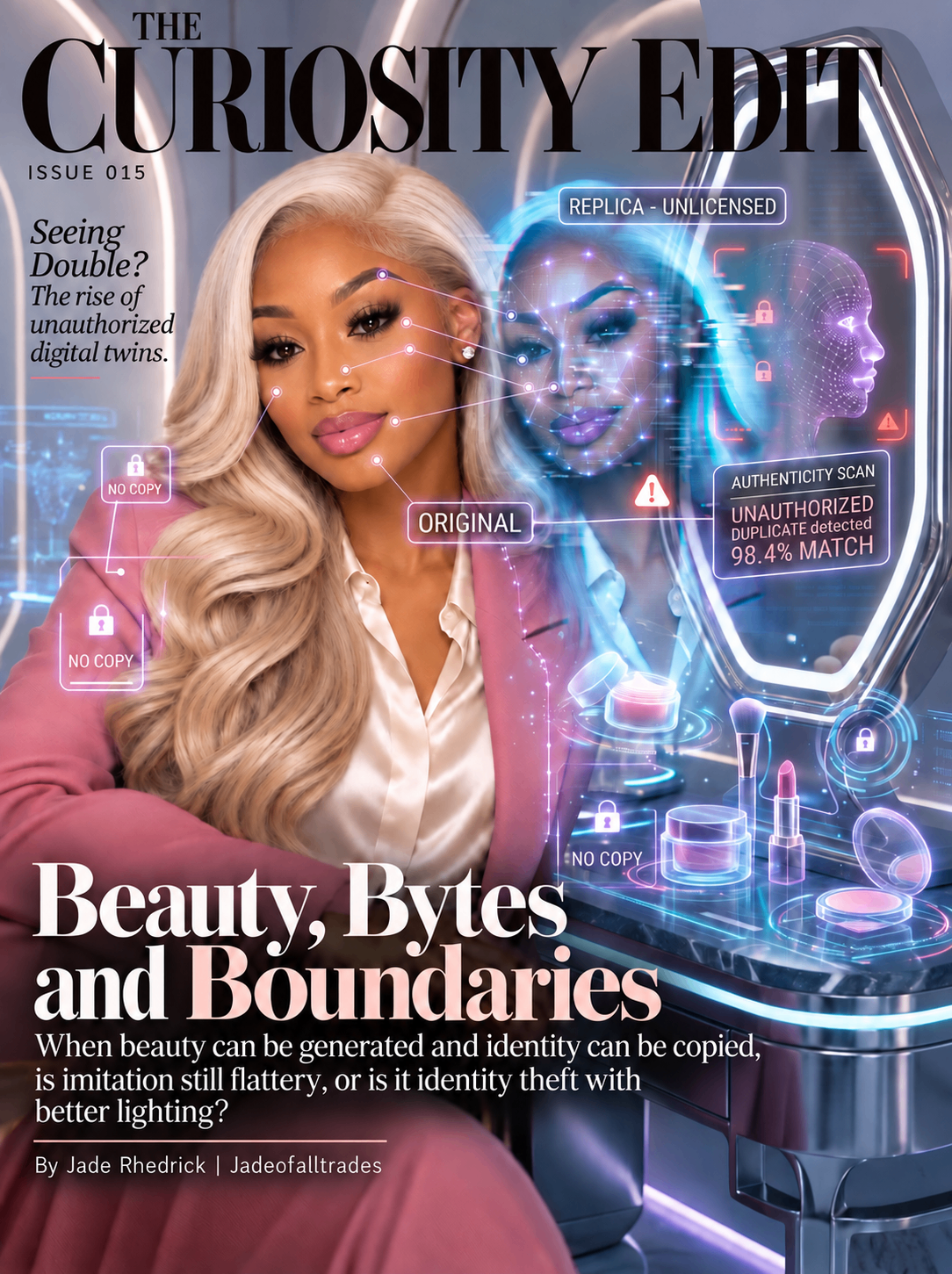
The mascara cannot take credit for lashes that were generated.
Content note: This issue discusses image-based abuse, child exploitation, stalking and extortion without graphic descriptions.
Let's Go Down the Rabbit Hole 🐇
She has flawless skin. Her lighting is always perfect. Her wardrobe could fund a small scholarship program. Somehow, she is available for every campaign, in every city, without ever missing a connection.
Her skincare secret? She may not have skin.
Welcome to a feed where the person selling the beauty standard might be a generated character, the model might be a licensed digital replica, and the familiar face in a video might never have participated in its creation.
These are different uses of technology, with very different consequences. They meet at a question we should be asking much more often: Who agreed to this, and who benefits?
As a mother, cybersecurity student, technology professional and creator, I see this conversation from several directions. AI can expand what we are able to imagine and build. It can also give old insecurities and abusive behavior new ways to reach people.
The opportunity deserves our curiosity. The consequences deserve equal attention.
The New Face of Influence May Be a File
A virtual influencer is a digital persona presented through social content. Some are created with conventional animation or computer graphics; others use generative AI. An AI-assisted photograph of a real person is another category. A digital twin is a replica of an actual individual. An unauthorized deepfake can misuse that individual's likeness without permission.
The distinction matters. A fictional character clearly introduced as fictional is a different proposition from an account passing itself off as a real woman, or an advertiser using someone's face without authorization.
The fashion industry is already experimenting. H&M announced the project in March 2025, and the first campaign imagery featuring digital twins of models followed in July 2025, described as a collaboration involving creative professionals and participating talent. That demonstrates an actual commercial use, though a company announcement does not establish the technology's long-term effect on jobs. [1]
On Instagram and similar platforms, synthetic personas can occupy the same visual space as human creators: outfit posts, aspirational settings, product placements and conversations with followers. The audience is still human, even when the personality performing for it is constructed.
That raises a practical question for beauty advertising. A generated face can illustrate a campaign concept. It cannot personally test a serum, experience acne or tell us how foundation wears through a humid afternoon. Brands should make that distinction unmistakable instead of letting an artificial appearance stand in for evidence of a product's results.
“The mascara cannot take credit for lashes that were generated.”
What Happens When the Beauty Standard Has No Body?
Beauty pressure did not begin with AI. Retouching, filters, selective casting and carefully staged lifestyles already shaped the feed. Generative tools add the ability to produce a seemingly photographic person whose appearance never had to exist in the physical world.
My concern is the comparison that follows: an actual young woman, living through normal changes in her face and body, measuring herself against an image with no biological constraints.
We should be precise about the evidence. The U.S. Surgeon General's social media advisory reports that 46% of surveyed adolescents ages 13–17 said social media made them feel worse about their body image. That finding concerns social media broadly. It does not measure the additional effect of AI influencers or prove that every teenager experiences the same harm. [2]
The specific long-term effects of today's AI beauty ecosystem remain uncertain. The plausible risks deserve investigation: more frequent exposure to impossible proportions, narrower ideas of acceptable skin and aging, and increasingly personalized images that make comparison difficult to escape.
There is also a question of whose beauty gets reproduced. If creators repeatedly request the same facial proportions, body types and skin finishes, the resulting images can reinforce existing preferences. Generating a wider range of appearances is possible, but inclusion requires deliberate choices.
For Black women and other underrepresented creators, I also want us to ask who owns the opportunity. A company can display a diverse synthetic cast while paying few of the people whose communities the images appear to represent. Visual representation and economic participation are separate measures of progress.
None of this means young women are passive or incapable of recognizing fiction. Many are sophisticated media users. But recognizing an image as artificial does not necessarily stop it from shaping what feels normal, desirable or expected.
A useful conversation with a young person might begin with: How does this account make you feel about yourself? What is it selling? What parts of the image are we being asked to believe?
That leaves room for connection and creativity, alongside skepticism.
Future Opportunities Will Depend on Who Controls the Rights
I expect more mixed workflows: human models working alongside digital replicas, creators using AI for production, and brands commissioning fully synthetic campaigns. This is an editorial forecast, not a prediction that human talent will disappear.
There are opportunities in creative direction, responsible synthetic production, likeness licensing, authenticity verification and trust and safety. Small businesses may gain access to visual concepts they could not previously afford. Creators may be able to work around disability, travel or caregiving constraints through carefully negotiated digital uses.
There may also be fewer paid assignments for some models, photographers, makeup artists and production crews. The ability to create more content does not guarantee that the people who previously made it will share in the earnings.
The decisive details will often be in the agreement. Who can generate a replica? For which campaigns? For how long? Can it be transferred to another company? Can it be used after the relationship ends? Does a new use trigger new compensation?
A model's consent to one campaign should not quietly become permission for an unlimited digital career conducted in her name.
For emerging creators, learning to evaluate those terms may become as important as learning the tools themselves.
Your Face Is Part of Your Brand, but You Are More Than an Asset
Protecting an online brand includes the trust attached to a name, face and voice. An impersonator can borrow that trust to promote a scam, fabricate an endorsement or redirect an audience toward a fraudulent account.
Sometimes “identity theft” describes this experience in everyday language. Legally, identity theft, impersonation, misuse of likeness and image-based abuse are distinct concepts. A copied face does not automatically fit every identity-theft statute.
For creators and business owners, a practical protection routine can include:
- Make your official channels easy to verify. Maintain a central page with your authentic accounts and contact information. Tell followers how legitimate partnerships or payment requests are communicated.
- Secure access. Use unique passwords or passkeys and strong multifactor authentication where available, especially for email and account recovery.
- Keep original records. Retain source images, publication dates, permissions and contracts. They can help establish what you created and what you authorized.
- Read likeness and AI clauses. Ask about training, replication, sublicensing, duration, prohibited uses and compensation before agreeing.
- Monitor and respond. Periodically look for impersonation accounts and unauthorized uses. Document URLs, usernames and dates before reporting.
These measures reduce exposure and improve response. They cannot guarantee that public content will never be copied. A watermark is not a lock, and account security cannot prevent someone from misusing a photo they can already see.
You also do not need a registered business, a large following or a commercially valuable image to deserve protection. A child's school photo and an ordinary woman's profile picture deserve the same respect for consent.
An Ordinary Photo Can Become Someone Else's Weapon
The FBI has documented criminals taking benign photographs or videos, including publicly posted material, and manipulating them into sexualized images used for harassment and sextortion. Victims include adults and children. Access to a private account is not always necessary. [3]
That means a person can be targeted without ever having created or shared an intimate image.
The resulting harm can extend beyond the original post: humiliation, bullying, fear of being recognized, damaged relationships, disruption at school or work, and the burden of repeatedly explaining that the image is fabricated. An abuser may threaten to send it to family, classmates or an employer unless the victim complies with demands.
“The fabrication does not make the coercion imaginary.”
We should also avoid treating all targeting as identical. Women and girls face particular forms of sexualized abuse, while boys and men can also be victims of image-based exploitation and extortion. Prevention must make help available without stereotypes about who is vulnerable.
Most of all, a victim's appearance, posting habits or willingness to be visible online does not transfer responsibility away from the person exploiting them.
This Is Also a Stalking and Violence Problem
The person misusing AI may be an organized scammer. They may also be a former partner, a stalker or someone exploiting access to a child. Technical sophistication is not a prerequisite for abusive intent.
In September 2026, the U.S. Department of Justice announced a 15-year sentence for an Ohio man whose crimes involved cyberstalking, real and AI-generated explicit imagery, and threats of violence. His convictions included publication of digital forgeries under the TAKE IT DOWN Act, the first conviction under that law in the country. The case connects synthetic media to sustained interpersonal harassment rather than a hypothetical future threat. [4]
The FBI has also highlighted a Charlotte child psychiatrist sentenced in 2023 for sexual exploitation of a minor and conduct involving AI-created child sexual abuse material. The agency described the alteration of ordinary images of actual minors. This was documented exploitation involving a person in a position of trust. [5]
Another route is fabricated urgency. The FBI warns that criminals use cloned voices in crisis schemes, including impersonating relatives to demand money. A familiar-sounding voice can make an emergency claim feel credible before the recipient has verified it. [6]
A staged kidnapping call does not establish that an actual kidnapping occurred. Equally, a threat involving fabricated imagery should not be dismissed as harmless. Threats, stalking and coercion warrant attention to the person's physical safety as well as the content circulating online.
For families, agree on ways to verify an emergency through an independently known number or trusted person. A family code word can be one additional check. If there may be immediate danger, contact emergency services.
The Law Has Started Responding
The following is a U.S.-focused overview checked October 7, 2026, not individual legal advice. Applicable protections depend on the content, conduct, location and facts of a case.
The claim that there are no laws against this is inaccurate. The claim that the problem has been solved is equally misleading.
| Protection | What it addresses | What readers should understand |
|---|---|---|
| Federal TAKE IT DOWN Act | Criminalizes certain nonconsensual publication of intimate visual depictions, including qualifying digital forgeries. Its platform provisions require a removal-request process. | Since May 19, 2026, covered platforms must remove qualifying content within 48 hours of a valid request and make reasonable efforts to identify and remove known identical copies. This is not a universal deletion guarantee or a prohibition on every kind of deepfake. [7][8] |
| Federal child-exploitation and obscenity laws | Can reach qualifying AI-generated or manipulated child sexual abuse material. | The FBI states that realistic computer-generated CSAM can violate federal law. The applicable statute and its elements still matter; “AI-generated” is not a blanket exemption. [5] |
| North Carolina's disclosure-of-private-images law | Expressly includes certain realistic AI-created or altered depictions of identifiable individuals and provides a civil action alongside criminal provisions. | The definition alone does not establish an offense. The statute's other requirements and exceptions must also be satisfied. Other states' rules differ. [9] |
| Laws addressing the surrounding conduct | Cyberstalking, threats and related offenses can apply when the conduct meets their legal requirements. | An investigation need not depend solely on whether an image fits a particular deepfake law, as the Ohio prosecution illustrates. [4] |
These protections address different parts of the problem. Removing an image, investigating an offender and obtaining a civil remedy are separate processes. Success in one does not automatically accomplish the others.
A takedown also cannot undo everything someone experienced before removal. Nor does it guarantee that altered copies or material on other services will disappear.
Governance Needs to Work Before Someone Is Hurt
As adoption grows, we need clearly assigned responsibilities across the companies building models, the services distributing them, the brands commissioning content and the platforms carrying it.
My proposed baseline would include explicit permission for real-person replicas; understandable limits on reuse; stronger safeguards around minors; testing for foreseeable image abuse; and reporting channels that a frightened person can actually navigate.
Commercial synthetic imagery should carry meaningful disclosure. But a label saying “AI-generated” does not supply consent or excuse exploitation. Detection tools and records of a file's origin can help establish context, but neither should become a single test that a victim must pass before receiving support.
There are difficult governance questions still worth pressing: Who is responsible when a licensed replica is repurposed? How are permissions withdrawn? What happens when an offender and platform operate across borders? How can evidence be preserved without keeping abusive content publicly accessible? How can repeat uploads be addressed without suppressing lawful material through mistaken reports?
Good rules need appeal mechanisms and safeguards against misuse, along with enforcement resources and practical remedies. Publishing a policy is only the beginning of that work.
Should AI Literacy Be Part of the School Curriculum?
If AI is already influencing what children see and believe, should learning to question it be optional?
My answer is that age-appropriate AI literacy belongs in school, supported by families and adequately trained educators.
UNESCO's student framework offers a starting point: it includes a human-centered mindset, AI ethics, techniques and applications, and system design. AI education can encompass judgment and responsibility alongside technical capability. [10]
For younger children, lessons can begin with understanding that pictures can be changed, asking permission before sharing someone's image, and knowing which adults can help when something online feels wrong.
For middle-school students, teaching can connect synthetic media to body image, advertising, privacy and peer pressure. Students should learn that a manipulated image can cause real harm and that forwarding it may extend the abuse.
Older students can examine evidence, bias, consent, likeness rights, commercial incentives and the limits of detection tools. They should practice verifying a claim through independent sources instead of relying on whether a video “looks fake.”
Schools also need a response plan: confidential reporting, prompt safeguarding, support for targeted students and proportionate accountability. A child should not have to demonstrate technical expertise to be believed or helped.
Those lessons can use fictional, age-appropriate examples. They do not require students to upload classmates' photos, create harmful material or surrender personal information to a commercial AI service.
If This Happens to You or Your Child
You do not need to prove that the image is authentic to deserve help.
- Prioritize safety and support. Tell a trusted person. If there is immediate danger, call 911 in the United States. For a child, respond calmly and make clear that seeking help will not get them blamed.
- Document the surrounding evidence. Record account names, URLs, dates, threats and report numbers. Do not download, forward or redistribute suspected child sexual abuse material to create an evidence folder.
- Report the content and the conduct. Use the platform's intimate-image or impersonation reporting process as appropriate. Report child sexual exploitation to NCMEC's CyberTipline, and internet-enabled extortion to the FBI's IC3. Threats may also warrant local law-enforcement assistance. [5][6]
- Avoid paying or sending more material. Compliance does not guarantee that an extortionist will stop. Seek help rather than negotiating alone. [11]
- Use removal support where eligible. NCMEC's Take It Down generates a digital fingerprint on your device for eligible imagery from when you were under 18. Only use material already on the device; do not download or ask someone to send it for this purpose. Its reach is limited to participating public or unencrypted services. NCMEC directs adults with eligible imagery from age 18 or older to StopNCII.org. [12]
NCMEC's service is distinct from the federal law with a similar name. For a covered platform's failure to comply with a valid removal request under the Act, the FTC accepts complaints at TakeItDown.ftc.gov. [8]
Before You Leave the Rabbit Hole
I want a future where women can build brands, experiment with AI, enjoy beauty and participate in public life without having to treat visibility as permission for exploitation.
That future asks something of everyone. Creators must be honest about what they make. Brands must be accountable for how they acquire and use a likeness. Schools must equip students to ask better questions. Technology companies and lawmakers must make protection usable in the moments people need it.
And young women deserve room to develop a relationship with their appearance that does not require competing with a body that never existed.
The next time a flawless face appears in your feed, let curiosity travel beyond the image.
Who created it? Whose likeness is involved? What are we being sold? And where does consent enter the picture?
Limitless looks good on you. Having boundaries belongs in the picture, too.
Continue the Conversation
Would you support age-appropriate AI literacy in school? What would you want a young person to understand about beauty, consent and identity before they encounter their next convincing synthetic image?
Sources and Further Reading
- H&M Group: H&M continues its exploration of creativity with AI, July 2, 2025 (project first announced March 2025). Primary industry announcement, not independent labor-impact research.
- U.S. Surgeon General: Social Media and Youth Mental Health. The body-image finding concerns social media generally, not AI-specific effects.
- FBI/IC3: Malicious Actors Manipulating Photos and Videos to Create Explicit Content and Sextortion Schemes, June 5, 2023.
- U.S. Department of Justice: Columbus man sentenced to 15 years for cyberstalking and AI-generated material, September 8, 2026.
- FBI/IC3: Child Sexual Abuse Material Created by Generative AI and Similar Online Tools is Illegal, March 29, 2024.
- FBI/IC3: Criminals Use Generative Artificial Intelligence to Facilitate Financial Fraud, December 3, 2024.
- FTC: Complying With the Take It Down Act, May 2026.
- FTC: FTC Begins Enforcing the TAKE IT DOWN Act, May 2026. See also the FTC's statute entry.
- North Carolina General Statutes, Chapter 14, Article 26, particularly § 14-190.5A.
- UNESCO: AI competency framework for students, 2024.
- FBI: The Financially Motivated Sextortion Threat, 2024.
- NCMEC: Take It Down, service scope and instructions.
✦ Limitless Reflection
“The next time a flawless face appears in your feed, let curiosity travel beyond the image.”
© Jadeofalltrades. Unauthorized reproduction prohibited.
Continue Exploring
Next Issue →
More from Cyber & Tech
Wired Differently, Built for Cyber
How neurodiversity, lived experience, and unconventional thinking can strengthen cybersecurity teams
Continue ReadingScript Kiddies, Now With a Copilot
When anyone can generate the code, who understands the consequences?
Continue ReadingThe Truman Show Has a Privacy Policy
Flock cameras, school laptops, and the disappearing boundary between being seen and being tracked
Continue ReadingRelated Reading
The Nightmare on Pine St.
I Bought a Land Bank Property. Here’s What Nobody Put in the Listing.
Continue ReadingThe Power of Showing Up Whole
In workplaces built around unwritten rules, authenticity can feel risky. But difference is not a professional deficiency, and credibility should never depend on how closely someone resembles the traditional image of success.
Continue ReadingCosmic Wanderlust: The Stars Said Pack a Bag
An Astrocartography Rabbit Hole on How Place Shapes Who We Become
Continue ReadingThe Curiosity Edit · By Jadeofalltrades